As part of the „Dance, Dialogue, Man, Culture” program block, we saw two male duets – from Poland and Hungary – on the Central Dance Stage. Although at first glance they were separated by almost everything: aesthetics, language of movement, tone of stage expression – the two performances came closer to each other where it matters most: in the story of relationships. About how we try to meet each other. How we pass each other by. How we build closeness, lose it, sometimes program it, and sometimes feel it without any scheme. These are two different views – but one common question: how is to be together and not lose each other?

BURDEN
Burden – a short, but extremely moving performance, telling the story of a relationship between two people, who with each movement reveal the intimate process of building a relationship. Or are they merely telling a fragment of a story already begun, into which we, the audience, suddenly enter by surprise? There is no room for superficiality on stage – every touch, every hesitation, every step is a testimony to mutual trust and an attempt to find a balance between being for each other and being with someone.
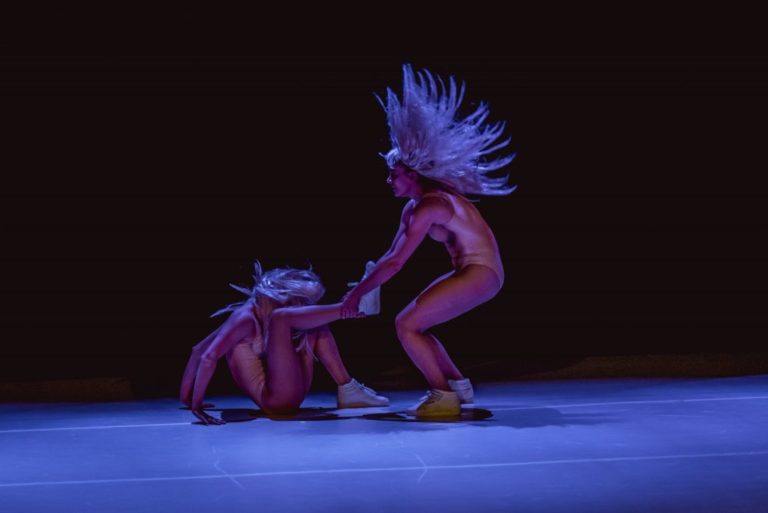
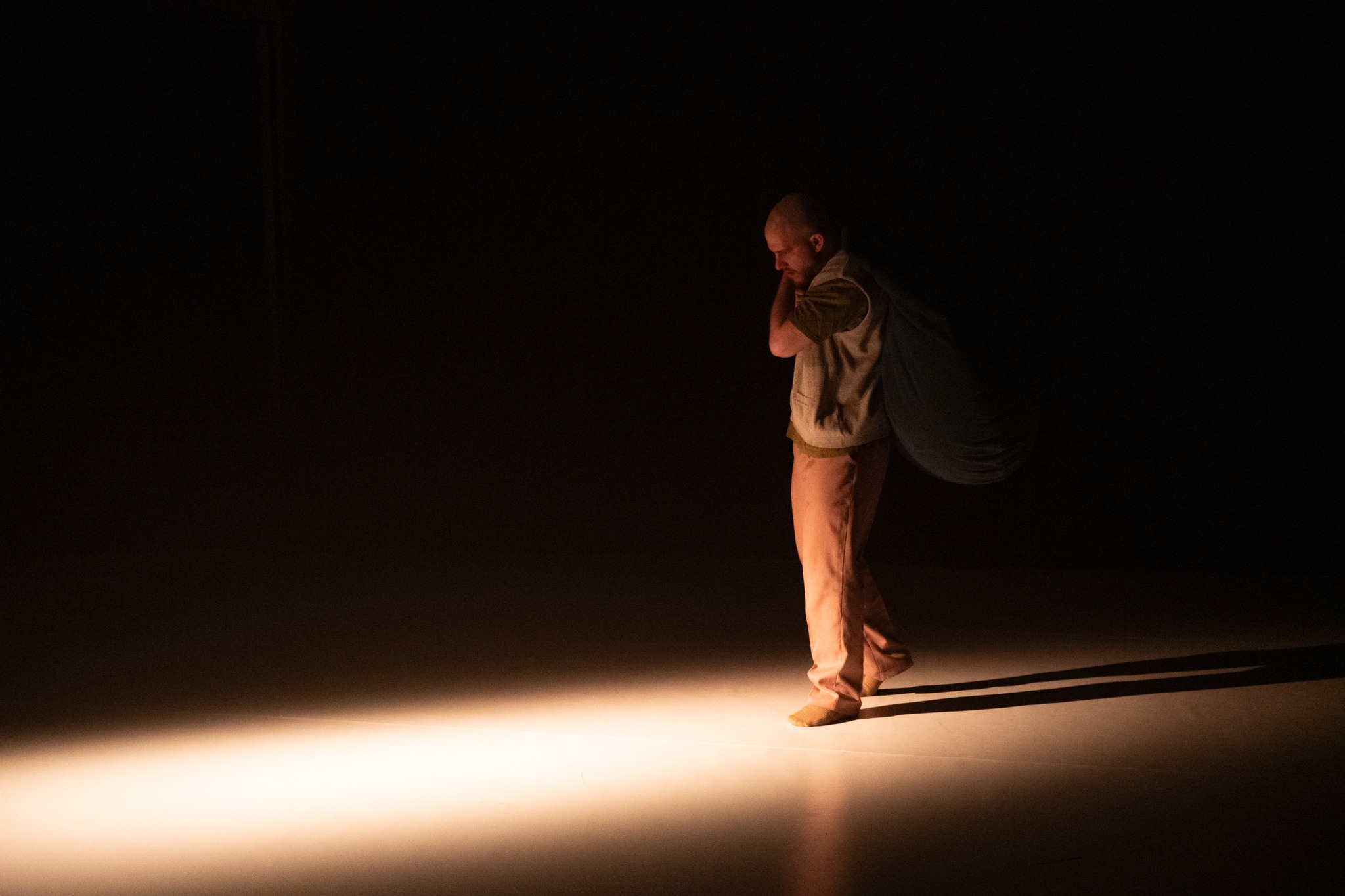
From the first moments, the images built by Attila Rónai and Roland Géczy drew me in and completely absorbed me. The warm soft light into which he slowly enters, carrying a huge gray sack on his back, his focus on each step, as his partner appears, gives way to dynamic choreography. The dancers are in dialogue. It’s a conversation without words, full of subtle impulses, suspensions and tempo changes. The dancers build tension. They wrestle with each other over the bag brought in, moving closer and further apart. Their bodies move from fluid, almost meditative phrases and tender gestures to violent arm movements reminiscent of tribal war dance. They tell a story in which every movement becomes a word and silence becomes a moment of greatest intensity.
The theme of identity in a relationship resonates extremely strongly in the performance. The artists show how easy it is to lose oneself in intimacy – how love or friendship can become a burden when we can’t breathe our own rhythm. When they try to direct each other, impose a pace or limit space tension is born. It continues until the moment of rebellion, when the independence of one of the dancers becomes necessary.
Burden does not accuse or judge – rather, it asks questions. Is it possible to have a relationship in which both parties are equivalent? Is it possible to be close without losing yourself? And how to recognize the moment when caring for another person becomes crossing one’s own boundaries, a bondage?
The dancers draw in their choreography from various streams of street dance, contemporary dance, folk dance, and contact improvisation, but do not conform to one aesthetic. This hybrid style creates a personal, emotional and sincere language. This diversity becomes a metaphor for relationships: complex, changeable, ambiguous.
The artists play with space in an interesting way – they create intimacy in which every movement seems like a whisper, at other times they explode with energy that almost spills off the stage. The viewer is drawn into their intimate journey, and although if he doesn’t know the dancers’ story, he recognizes his own experience in it.
The performance is an emotional map of relationships, in which every gesture carries the burden (or lightness) of being with someone. It’s a play about tenderness and strength, about the need to be accepted and about boundaries that are worth recognizing and putting up. It’s a reminder that the most difficult, but also the most important task in a relationship, is to remain ourselves – even when our greatest desire is to exist for someone.
MIAZGA
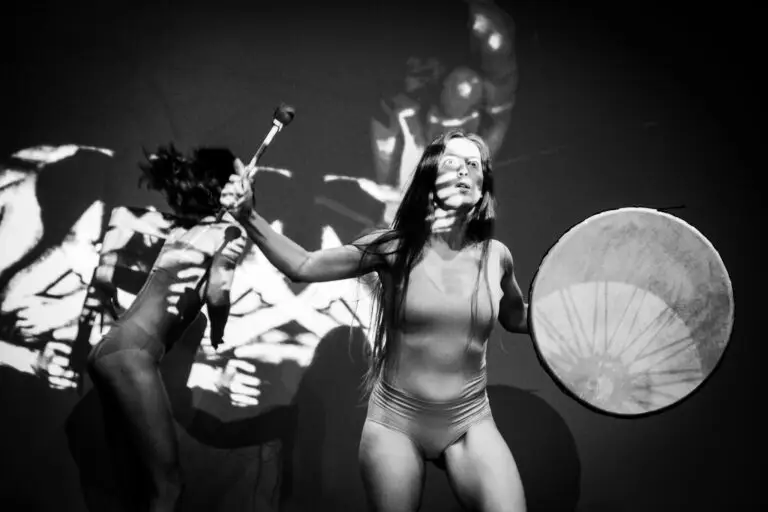
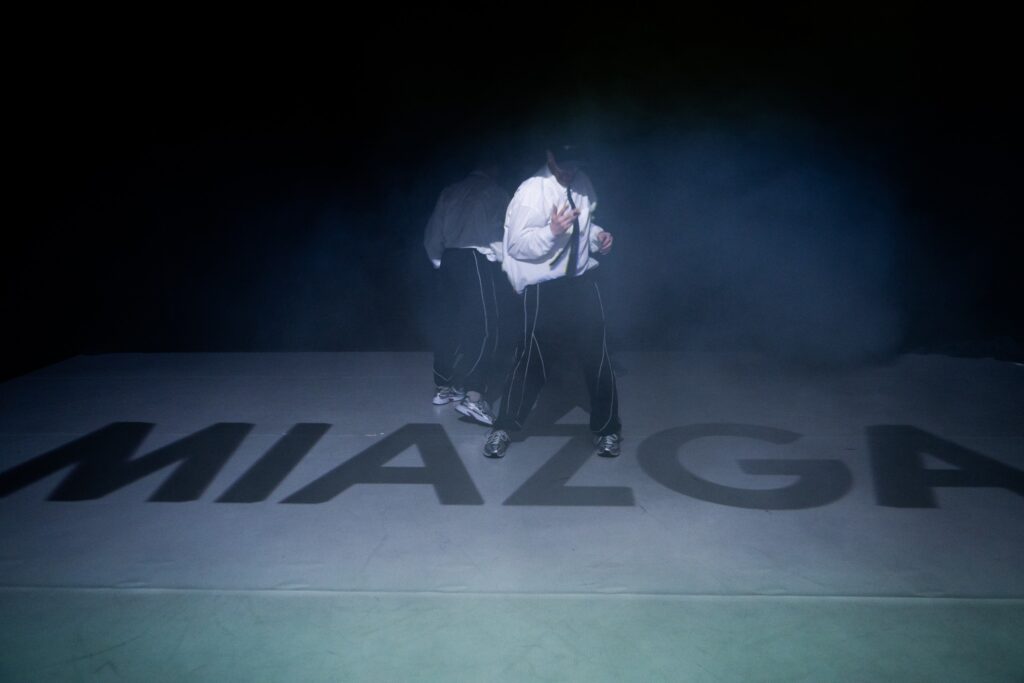
Miazga (The Pulp) by Stanislaw Bulder and Artur Grabarczyk is a performance, a kind of choreographic play on decoding oneself. The dancers’ bodies become a laboratory, and the stage becomes a playground and a battlefield at the same time. All this with an ironic smile and a certain insolence, which acts on the viewer like an electrical impulse – once tickling, once irritating, and sometimes surprising with deep reflection.
The avatars move as if someone threw into their system a peculiar, minimalist code that has nothing to do with the logic of everyday relationships, yet surprisingly accurately reflects them. Their movements are precise, fragmented, perhaps even absurd at times, as if they were trying to describe complex emotions with just a few available commands. Occasionally something hangs up, something skips, something glitches – and it is in these micro mistakes that comedy is born.
Miazga is like a flirtation with one’s own nervous system: a bit awkward, sometimes very intimate, but fascinating nonetheless. The dancers play a kind of game – both with each other and with the audience. They try to catch a rhythm that eludes them every now and then, they try to communicate with each other in a language that constantly confuses them. And although they play the role of machines that follow a code and carry out instructions, their bodies betray human impulses – hesitations, reactions, micro-emotions. The performance is full of exaggerations. The dancers balance between rigid mechanical repetition of movements and bursts of expression, as if they want to reprogram themselves, but the system throws an error every now and then: error 404 – sense relation not found. Their movement is a combination of isolation, surges of tension and choreography that acts like a series of „commands” sent to the body – with the expectation that something will eventually happen.
Bulder and Grabarczyk not only play with avatar conventions and brainfuck language. Their performance is also a perverse reflection on how much we would like to automate human relationships – simplify them, program them, make them something predictable. And yet every relationship is chaos, systemic errors, unexpected twists and moments of complete incompatibility.
Although the performance speaks the language of movement and abstract code, it is surprisingly close – full of allusions to everyday social rituals, attempts to fit in, misunderstandings and all those absurdities that accompany us when we try to be „in touch” with another person.
Miazga plays with form, breaks patterns and doesn’t take itself too seriously – which is a huge asset of this show. It is like a brilliant commentary on our attempts to be a „functional human being in a relationship” – and at the same time a reminder that not everything can be written in code.
Choreography: Attila Rónai & Roland Géczy
Dancers: Attila Rónai & Roland Géczy
music: Hámor József
Costumes, light direction: Attila Rónai & Roland Géczy
trailer: Kristóf Deák, editing Attila Rónai & Roland Géczy
direction, choreography, performance: Stanislaw Bulder, Artur Grabarczyk
concept: Artur Grabarczyk
costumes: Stanislav Bulder
music: Zuzanna Henclik, Bartosz Kalwasinski
visuals: Gary Garnowski
visual identification and documentation: Maria Łozińska
light direction: Stanislaw Bulder, Artur Grabarczyk
realization of light: Filip Ejsmont
photos: Zuzanna Czaplak
production coordination / h.art: Beata Miernik
dramaturgical support / substantive supervision: Katarzyna Kania
production: Institute for Urban Culture in Gdańsk, h.art company, Stacja Orunia GAK
The performance MIAZGA was created as part of the Spaces of Art – Dance program, whose operator in Gdansk in 2024 is the Institute of Urban Culture. The Spaces of Art program is funded by the Ministry of Culture and National Heritage, implemented by the National Institute of Music and Dance.
project: Central Dance Stage in Warsaw edition VI
Organizer: Mazovian Institute of Culture, PERFORM Artistic Foundation
co-financed by the city of Warsaw