Vertikal and Phénix is not only a show of choreographic mastery, but also a profound manifesto of creative freedom. Mourad Merzouki, a master of combining styles and pushing boundaries, constructs worlds where the dancer gets rid of the weight of the body, and the sounds of hip-hop, electronic music and J.S. Bach sound in an unlimited space.
Mourad Merzouki creates two completely different worlds – one suspended somewhere in the air, the other remaining in intimate proximity to earth and sound. Vertikal and Phenix are performances that operate with different codes of expression. The dancer’s moving body not only shapes the stage space, but also crosses its boundaries – in vertical, horizontal, rhythm and tension.
Upward overcoming the weight
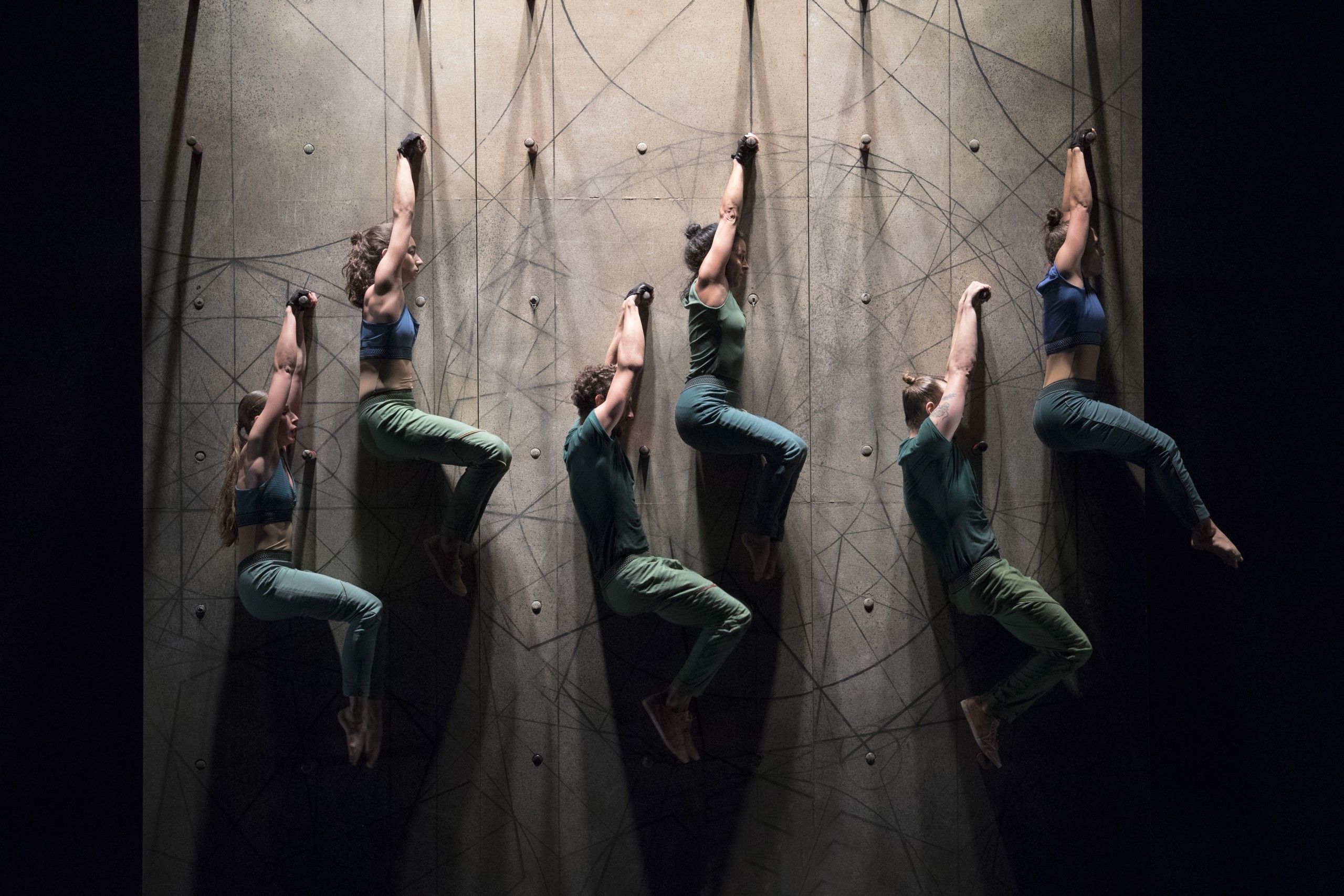
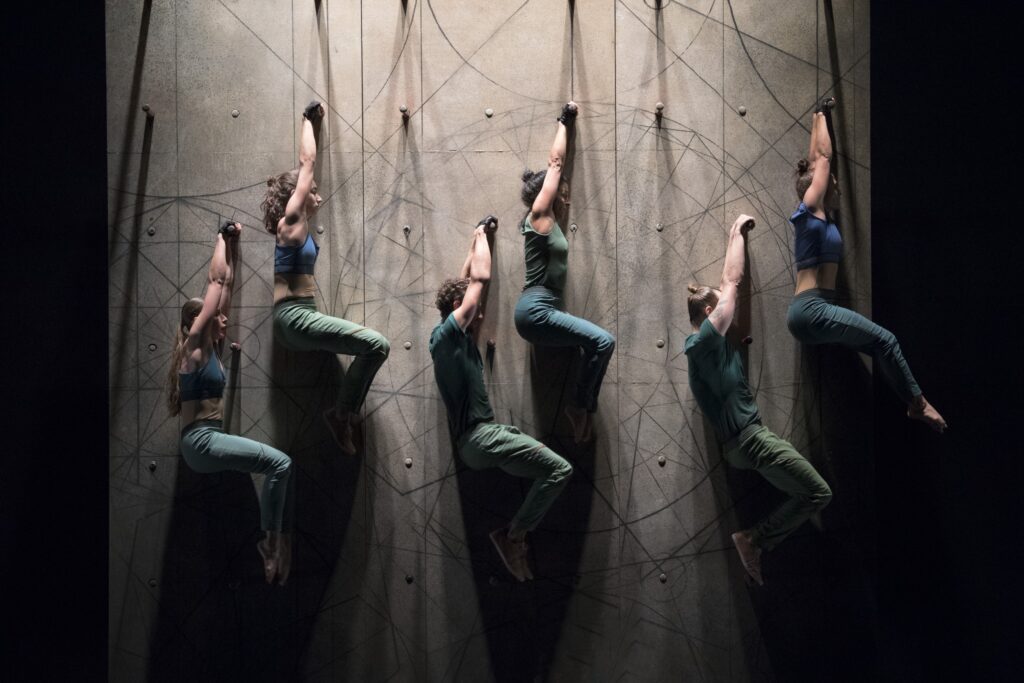
Vertikal is a kind of experiment with gravity – dancers float on ropes, move vertically, levitate above the stage. However, this is not a show of acrobatics, but a dance composition full of lightness and grace, in which every movement is well thought out, based on the tension between the body and the surrounding space. The choreographic language here, requiring great control from the dancers, consists of smooth but tense transitions. Moving silhouettes seem to hang in the air, they are full of unusual expression – gestures become as if elongated, undulating, it seems that their bodies are drawing some invisible trace in the air. The dancers descend and ascend to the rhythm of Armando Amar’s music, the tempo seems almost organic. The space around them does not exist as a background – it is a participant, a partner. The violent howls of the body contrast with moments of calm, in which the dancers hover above the stage, suspended between the sounds of the music and the movement. The drama is built by the rhythm. What begins as a play with height ends as a meditation on the body in uncertainty.
A system of harnesses, ropes, and hitches allows the dancers to fly vertically and diagonally; the technical elements are visible – they become part of the stage design and visual construction of the performance. The space is open, black, indefinite, yet it gives the impression of some unusual density thanks to the light. The spotlights cut the air, drawing lines, which further give a geometric touch to the whole choreography.
Lighting becomes the architect that creates the framework within which the dancers move, delineates planes and accentuates directions. Sharp contrasting whites against darkness and point sources of light enhance the effect of suspension between the real and dreamlike worlds.
In search of the subtleties of body and sound
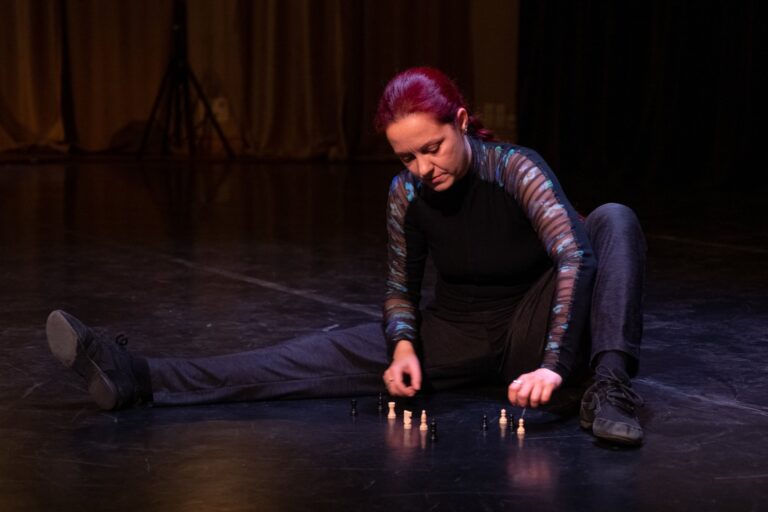
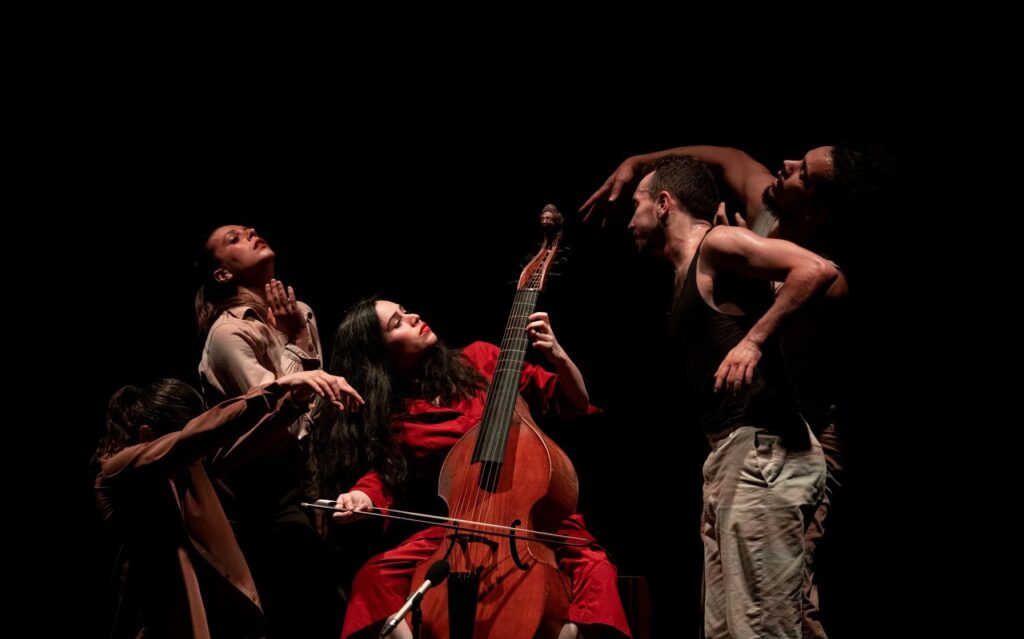
Phénix is in a sense the opposite of Vertikal. The center of the performance here is not space or acrobatic movement, but the deep and intimate relationship between the music and the dancers’ bodies. On stage, a cellist dressed in a fiery red gown. Next to her, in the semi-darkness, the silhouettes of the four dancers may be seen moving in concentration to the sounds of the Baroque viola da gamba. The choreography does not illustrate individual musical phrases, but dialogues with the melancholy sound of the instrument. It is full of delicate, soft, tender yet precise movements, minimal impulses. The composition puts the viewer almost in a contemplative state. Phénix’s dynamism comes not from physical energy, but from emotional tension. The dancers listen to each other’s bodies, each step a response rather than an initiative. In the sequences of duets and trios, one can see perfectly how the intimacy of movement can build drama without the need for effects, relying on repetition and hesitation.
The space is empty. The only element of the scenery is the instrument, its sound and light, which evokes emotions. Its warm, amber tones create an atmosphere of concentration. The lighting changes are subtle, often almost imperceptible, as if they want to follow the movement. The combination of viola sound and electronic textures by Arandel creates a dialogue with movement – the body not only dances to the music, but co-creates it. It is not clear where the sound ends and the gesture begins.
Master of choreography of emotions and space
Although Vertikal and Phénix are extremely different in form, they share what could be called a common philosophy of the body. Mourad Merzouki treats them as a storytelling medium sometimes suspended in space, sometimes immersed in silence. Choreography becomes a form of communication with the viewer. Gesture, movement, gaze – everything becomes a carrier of meaning. In Vertikal, movement crosses physical boundaries, in Phénix – the boundaries of intimacy. In the first performance, space determines the dynamics of the body, in the second, the body organizes the space of silence. Once again, dance becomes a vehicle that takes the viewer beyond the confines of the familiar.
Mourad Merzouki once again proves that his approach to dance is not just a formal experiment. Both performances are deeply humanistic works that touch on fundamental themes: freedom, presence, relationships. Their strength lies in the fact that they do not impose a narrative – they offer experience and a multiplicity of interpretations.
It’s a dance you can not only see, but also feel: in the rhythm of your own breathing, in the trembling of your own body in the audience. Whether it’s a movement suspended in the air, or a gesture as fleeting as a sigh – it stays with us long after the spotlights go out.
Original text in Polish published at: https://taniecmagazyn.pl/numer-pelen-emocji-lato-z-magazynem-taniec/
PHENIX:
Musical and dance performance by the Compagnie Käfig ensemble (France)
Artistic direction and choreography: Mourad Merzouki
Assistant: Kader Belmoktar
Live music (viola da gamba): Garance Boizot
Electro music: Arandel
Lighting design: Yoann Tivoli
Dancers: Coline Fayolle, Aymen Fikri, Hatim Laamarti and Maureen Brut-Coutté
Co-production:
Pôle en Scènes, Encore Un Tour, Ambronay Festival
A performance created with the support of:
Centre National de la Musique
Premiere: 25.09.2022 r.
During the XXXI BFO: May 3, 2025 at 7 p.m., May 4, 2025 at 6 p.m.
Duration: 1 hour
VERTIKAL:
Artistic direction and choreography: Mourad Merzouki
Assistant choreographer: Marjorie Hannoteaux
Music: Armand Amar
Set design: Benjamin Lebreton
Preparation of the air stage space: Fabrice Guillot / Compagnie Retouramont
Equipment deployment: Yves Fauchon
Air training: Isabelle Pinon
Lights: Yoann Tivoli in collaboration with Nicolas Faucheux
Costumes: Pascale Robin, assisted by Gwendoline Grandjean
Dancers: Francisca Alvarez, Rémi RMS Autechaud, Kader Belmoktar, Sabri Mucho Colin, Alba Faivre, Anaëlle Echalier, Pauline Journé, Maé Nayrolles, Teddy Verardo, Médésséganvi Swing Yetongnon
Production: National Choreographic Center Créteil and Val-de-Marne / Käfig Company.
Co-produced by Lyon Dance Biennale, National Stage of Southern Aquitaine, Maison des Arts de Créteil
A performance created with the support of: Comédie de Valence
Premiere: 8.09.2018 r.
On XXXI BFO: 3.05.20025 at 19.00 and 4.05.2025 at 18.00.
Duration: 1 hour 10 minutes