Dancing Behind the Wall. The Symphony of the Whispering Walls by h.art company.
Dancing Behind the Wall. The Symphony of the Whispering Walls by h.art company.
September 2, 2023 marked the Polish premiere of The Symphony of the Whispering Walls. It was inspired by Mieczyslaw Wejman’s graphic art series The Dancers. British choreographer of Albanian descent Erion Kruja breathed the spirit of unknown characters from the Warsaw Ghetto into the bodies of the dancers.
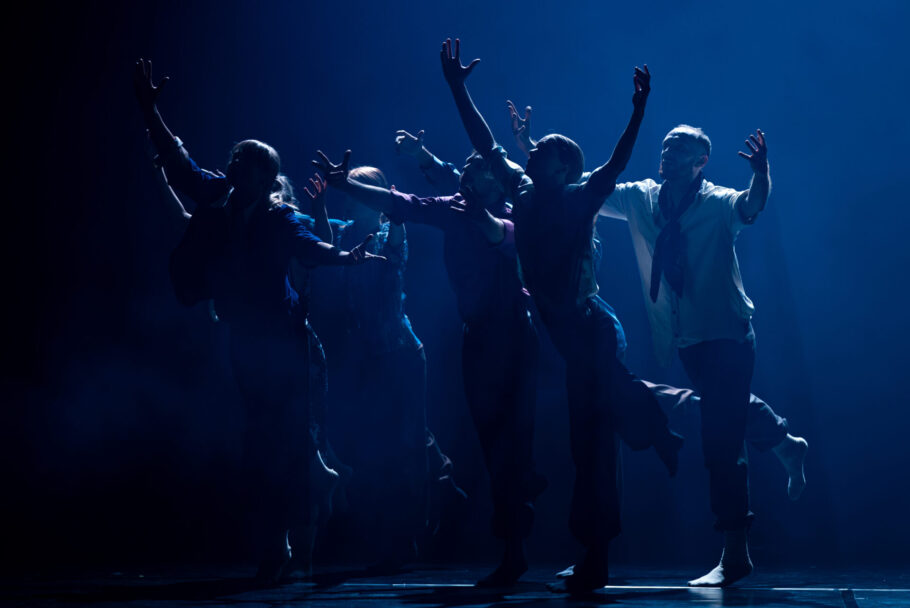
In the darkness of the stage, far in the background, the dark silhouettes of the dancers may be seen. The barely visible group moves slowly, their fluid movements harmonize with music resembling one continuous murmur. Three men and four women, surrounded by smoke, seem to be floating in a fog – no one knows where they are from or where they are going. They are delicate, ephemeral, every now and then they freeze for a brief moment in some kind of dancing pose. Are they pretending to be characters sketched by Wejman, who was hiding from the Gestapo? In the background one can hear voices, whispers, breaths, as it were, which mix with the sound of the violin, with music. Erion Kruja’s choreography is mesmerizing – not only the dancers seem to move in a trance, but the viewer himself succumbs to the magic of the images flowing before him. The action unfolds slowly, allowing the viewer to enjoy the eye with the changing spotlight and create his own interpretations of the dance steps.
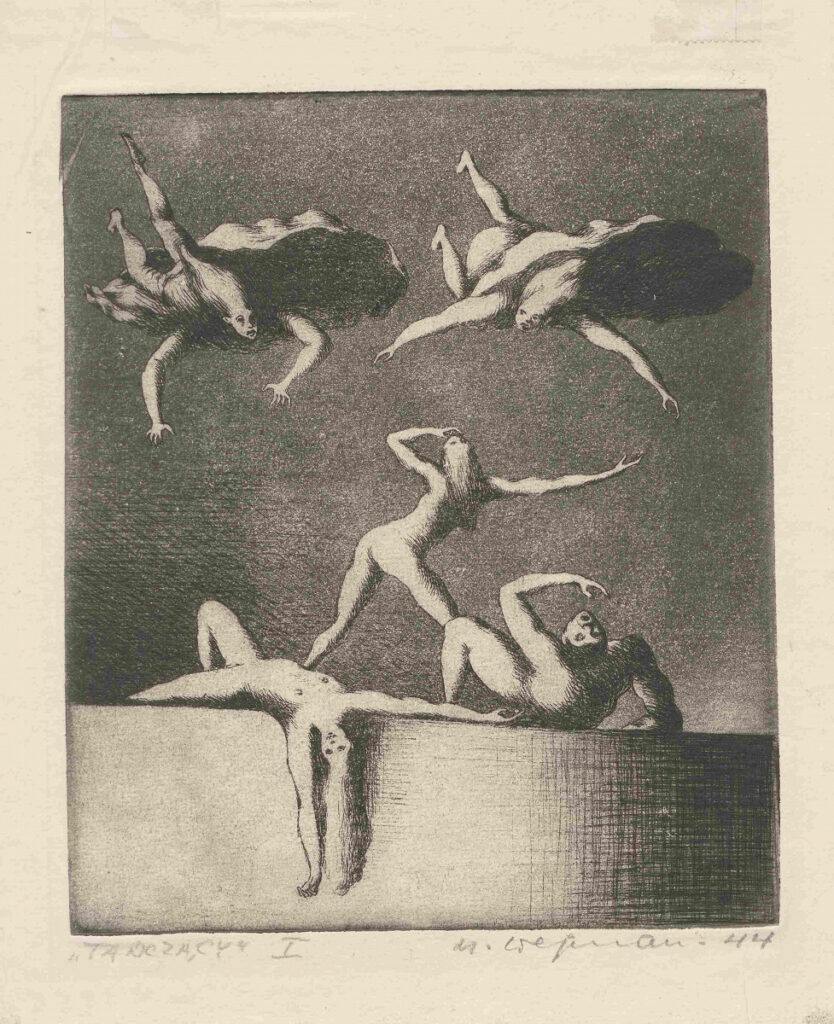
Mieczyslaw Wejman created more than a hundred works during the war. These included drawings, paintings and prints. The Dancing series, made using aquatint and etching techniques, is a poignant picture of occupied Warsaw, allegorically documenting the lives of Jewish ghetto residents and victims of the 1943 uprising. The dance that Wejman depicts is not a joyful dance in which the body is free and open; it is a forced dance, full of tension, and is an element of oppression for the dancer – a movement against the performing body. Similar elements appear in the h.art company’s performance. Here, soft sequences of smooth movements are interspersed with exertion-filled, endlessly repeating, almost murderous dance passages. This effect is further enhanced from time to time by the cold light of a strobe, cutting the stage space into individual film frames – vibrating, disturbing pieces of images.
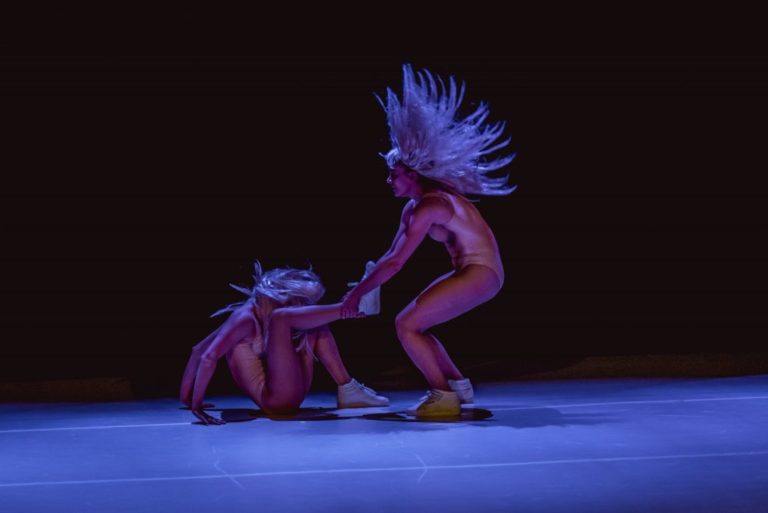
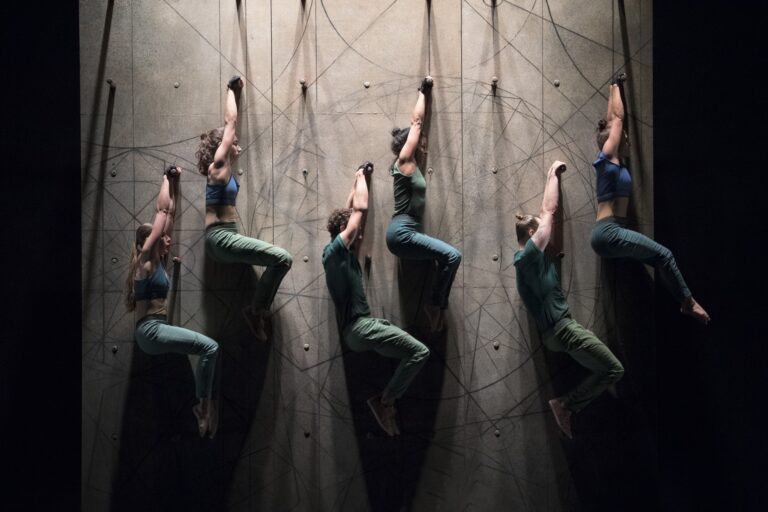
In fact, the entire performance is a collection of choreographic impressions, separated by blackouts – moments when the stage sinks into complete darkness. These blackouts, in a way, separate the chapters of this moving story, unfortunately, at the same time depriving the performance of a certain fluidity. However, this is a deliberate procedure, aimed at jolting the viewer out of his reverie and abruptly redirecting his attention to a new thread. Out of the darkness emerges a group of characters dancing in a rhythmic, synchronized pattern. They are in ordinary everyday clothes kept in warm, muted colors. Their bodies seem fully harmonized, almost united. Nevertheless, suddenly the group scatters, and one of the dancers stands alone in front of them. It’s a motif that repeats throughout the evening, just like in Wejman’s works, in which the artist – dancer, actor, acrobat – performs alone, in opposition to some group. From time to time, the dancers swap roles, and each artist, at least for a brief moment, becomes the “other,” observed, being next door. The division between dancers and observers, in which a helpless individual faces, a soulless crowd, is not only marked on stage, when an artist performs a solo part against the backdrop of a group. It’s also a division between performers and audience, in which we involuntarily stand on the other side as witnesses to the events, those who have a chance to capture some unique snippet of one of the many stories presented here, or just ordinary casual onlookers, especially at moments when the dancers suddenly freeze on the proscenium resembling a group posing for a photograph. Back-lit dancers resemble the black silhouettes of Wejman’s aquatints. Their bodies give the impression of fatigue, bending under an invisible burden, as if broken by fate. They dance in duets and trios. Alternately, one gives direction to the other, dictates the rhythm and tempo, still under the gaze of an audience that is indifferent, because not directly involved in this dance. At other times we look at young men and women frozen in motion. Expressive gestures and dynamic poses are as if frozen in an unexpected frame of figures from behind the wall – the wall of the ghetto, which Mieczyslaw Wejman saw so often, and even passed by for a time, while working in a factory located on its grounds.
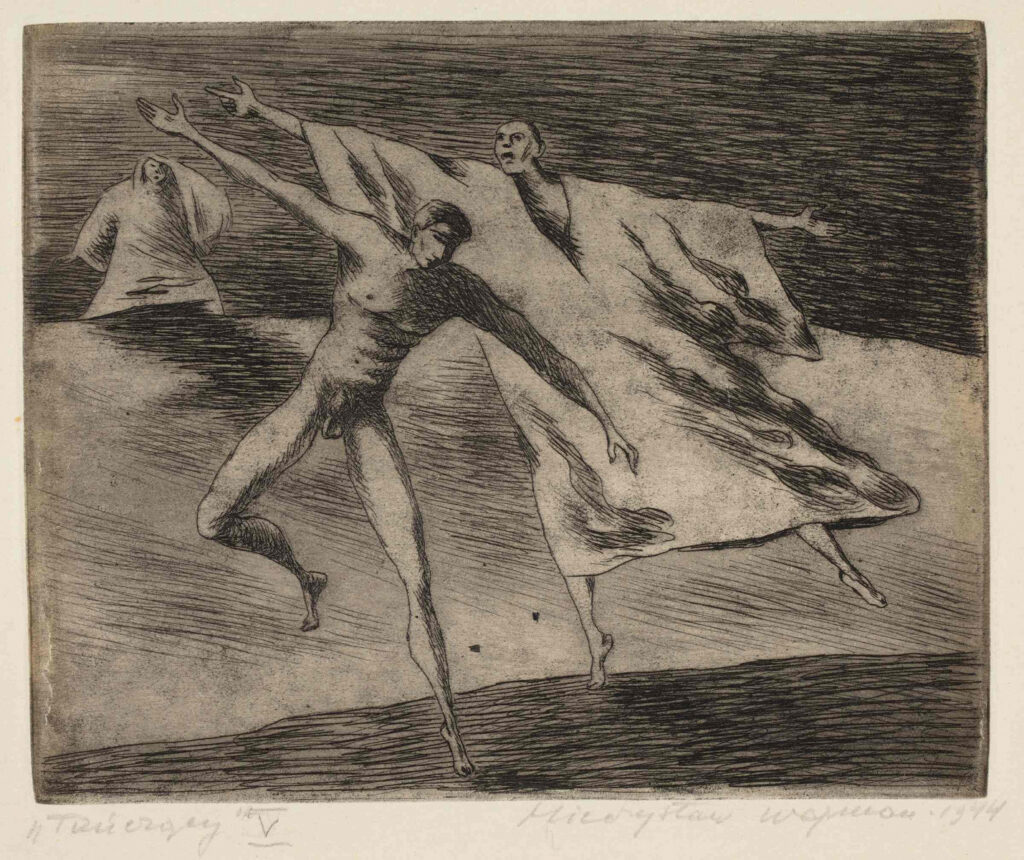
Watching the performance, I have the impression of remaining in some undefined space, in some unknown time – between worlds. The dancers seem to be a bit like ghosts, creating an image composed of fragments of memories, stories, true and fictionalized or distorted over the years, recalled from memory. At one point, instead of silhouettes, cloth-clad figures appear on stage. The spotlight glides over them, bringing out every now and then a hand, the outline of a head, an arm, a hip from the disturbingly twisted shapes. Erion Kruja’s phantoms are somewhat reminiscent of Francisco Goya’s engravings, which Mieczyslaw Wejman was so inspired by. Among his works, too, there are figures dressed in voluminous gowns or draped in broad cloth – dehumanized, unreal, reminiscent of medieval danse macabre, equating everyone and everything in the face of inevitable death. They resemble dreamy nightmares or deformed human bodies. The dancers are trying to get out of these elastic cocoons, to break the material encasing them with the hard-to-define warm color of earth, clay, dust… From dust you were made, to dust you shall turn… Perhaps this is just a random association, or perhaps this scene is a metaphor for the wheel of life and death – a cycle that lasts as long as life exists.
Between birth and death, however, there is something else that gives meaning to human existence regardless of circumstances. It is love. The noblest of feelings, the strongest, causing joy and suffering at the same time, but also capable of bringing relief when the surrounding world is filled with violence, hopelessness, decaying, falling apart – literally and figuratively. In the warm light of the spotlights, as in the glow of the setting sun, the youngsters dance with their foreheads touching. The couple tenderly touch each other, their bodies rippling slightly in a salsa-like rhythm, moving closer and further apart. They give the impression of being absorbed in each other and the moment. There is a lot of peace and mutual tenderness in their mutual presence. Their dance is a gentle act of love, a deviation, an aberration in the gray hopeless reality that surrounds them. This intimate duet is so filled with deep feelings of warmth, acceptance and so different from the other choreographic sequences that one would like to watch it again and again; it could last beyond time, like the passion that gave birth to it.
There is another motif in Mieczyslaw Wejman’s works, in my opinion the most poignant, because it illustrates and symbolizes the horrors of war – floating silhouettes. The wide-spreading arms of the flying figures of men and women against the sky, some naked, others in long white robes, reminiscent of the Inquisition convicts of the autodafe procession, to which Goya so readily returned in his works. For many years, critics and art historians described them as purely allegorical paintings. Today we know that they are poetic records of real events, fragments of memories from the burning ghetto, when the only choice was to burn alive or die, jumping out of the window of a burning tenement and smashing into the cobblestones. The motif of wide-spread arms recurs every now and then in Erion Kruja’s choreography. On the one hand, the dancers’ arms raised upwards are a beautiful gesture of opening, on the other – they resemble the residents of the Warsaw Ghetto being wiped off, jumping out of the windows.
Rhythmic steps, heads raised slightly, arms stretched toward the sky – the dancers in the compact group seem to be part of a larger procession. They repeat the dance sequences more and more intensely, with increasing effort, as if each move would be their last. The final dance has something of the medieval dance of death in it. It is a balancing act on the edge of life, an act that equates everyone and everything in the face of the end of time. It is a dark dance, filled with anxiety and a feeling of the inevitability of fate. The artists seem to be in some kind of nightmarish trance. Almost extremely exhausted, they start humming some cheerful melody, somewhat reminiscent of uprising songs or popular songs of the interwar period. Their voices pierce more and more through the rhythm of the electronic music, and when the music falls silent, the dancers are left alone on stage with their melody. Now more casual, they hum it while still dancing.
The Symphony of the Whispering Walls is a performance that is a gallery of extremely moving images that each viewer will probably interpret differently. The movements of the dancers’ bodies, the play of lights and the sounds of music are merely theatrical substance, accelerating and intensifying the work of the imagination. They provide a starting point for reflection on the intertwining of love and hate, suffering and freedom, and the whole range of feelings and sensations that fill human life. It is worth asking if this is why it is not so precious?
The original text in Polish was published at https://taniecpolska.pl/krytyka/tanczacy-za-murem-o-spektaklu-h-art-company-the-symphony-of-the-whispering-walls/
Premiere: September 2, 09/2023 at 7 pm, STUDIO theatrical gallery (alternatively: Studio Theater).
Production: h.art company, Grab Art Foundation
Choreography and music: Erion Kruja
Concept: Agnieszka Brzezinska
Assistant choreographers: Agnieszka Brzezinska, Artur Grabarczyk
Cast: Agnieszka Brzezinska, Natalia Filowiat, Artur Grabarczyk, Agnieszka Jachym, Zuzanna Strugacz, Kacper Szklarski, Szymon Walawender, Zosia Wieteska
Artistic director: Artur Grabarczyk
Production Manager: Beata Miernik
Co-production: Ministry of Culture and National Heritage, National Institute of Music and Dance, Warsaw Ghetto Museum
Honorary patronage: President of the City of Warsaw, POLIN Museum
Partners: the Janina Jarzynówna-Sobczak Comprehensive Ballet School in Gdansk, the Studio Theater, the Young Propagate Art Foundation
Media patronage: TVP Kultura
Media support: taniecPOLSKA.pl, TANIEC, Museum of the Second World War
The performance was subsidized by the National Institute of Music and Dance within the framework of its own Choreographic Orders 2023 program financed by the Ministry of Culture and National Heritage.